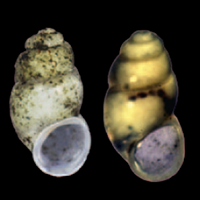
Pontobelgrandiella Radoman, 1973 (Caenogastropoda: Hydrobiidae): a recent invader of subterranean waters?
DOI:
https://doi.org/10.61733/jconch/42407Keywords:
Balkans, troglobiont, stygobiont, Pleistocene, phylogeographyAbstract
The cytochrome oxidase c subunit I (COI) partial sequences of all the nominal species of Belgrandiella Wagner, 1927, and Pontobelgrandiella Radoman, 1973 described so far from Bulgaria, collected from 16 populations, have been studied. The results rejected the occurrence of any representative of the genus Belgrandiella in Bulgaria since all the populations belonged to Pontobelgrandiella. 60 sequences have been studied, among them eleven COI haplotypes (haplotype diversity Hd = 0.870) have been identified. Divergence level has been small, with nucleotide diversity = 0.0078 and 14 variable sites. With an exception of one population, no intrapopulation polymorphism has been found. The haplotypes formed four clades, with low p-distances between them (0.7–1.5%). The clade I, represented by eight populations, all found in the Balkan Mountains, has been characterised by the highest divergence (five haplotypes, p = 0.6–1.2%, thus 3–6 point mutations). The clade II, with one haplotype, has been found at two localities distant one from another. The clade III with three haplotypes, and the clade IV with two haplotypes, have been found at small areas. The Principal Component Analysis of seven shell measurements showed some morphological distinctness of the representatives of the distinguished clades, although with some overlapping variability. The lack of polymorphism may reflect a founder effect, bottlenecks during subsequent local extinctions and/ or drastic reductions of population size, and may also be a result of strong selection. The genetic distances between the clades: 0.7–1.5%, would indicate the time of divergence from 0.38–0.43 Mya to 0.81–0.92 Mya. Thus the divergence took place in the Pleistocene, more precisely in Calabrian and Middle Pleistocene. It suggests that the adaptation of Pontobelgrandiella to troglobiont and stygobiont habitats was quite recent, and still incomplete. The results seem to follow the “climatic relict” model. The Pleistocene unstable climatic conditions might have promoted the adaptation of this snail to underground waters.