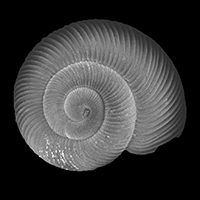
Stephacharopa miqueli sp. nov., a new terrestrial microsnail (Gastropoda: Charopidae) from the central Chilean coast
DOI:
https://doi.org/10.61733/jconch/4593Keywords:
Punctoidea, South America, Stephadiscus, Stephanoda, StylommatophoraAbstract
In Chile, punctoidean microsnails of the family Charopidae, Cystopeltidae, and Punctidae, characterised by having shells only a few millimetres in diameter, are one of the most species-rich groups of land snails. However, few studies exist on this fauna, mainly due to the small size of punctoid snails and the specialised techniques used for their characterisation. In this work, we describe a new species of Charopidae, Stephacharopa miqueli sp. nov., from Santo Domingo, Región de Valparaíso, in central coastal Chile. The new species is characterised by its minute discoid shell (to 1.98 mm in width); a comparatively large protoconch with about 52–66 weak, low radial ribs; and a teleoconch with about 112–124 weak ribs, with a distinct protoconch–teleoconch transition. The new species is the first Stephacharopa recognised from central Chile, and it can be distinguished from the five other extant species of the genus by differences in shell morphology, including teleoconch and protoconch sculpture. The discovery of a previously unknown microsnail in a densely populated, human-modified landscape highlights the importance of microhabitat refuges in central Chile, such as native vegetation patches and rocky outcrops, which support the survival of native species.
References
Araya JF. 2016. On some land snails (Mollusca: Gastropoda) of Los Molles, central Chile. Revista Mexicana de Biodiversidad 87 (4): 1365–1368. https://doi.org/10.1016/j.rmb.2016.10.002
Araya JF, Miquel SE. 2018. A new Stephacharopa (Gastropoda: Punctoidea) from Paposo, northern Chile. Journal of Conchology 43 (2):129–133. https://doi.org/10.61733/jconch/43201
Araya JF, Miquel SE, Martínez E. 2017. New records of terrestrial mollusks (Gastropoda: Stylommatophora) from Antofagasta, northern Chile. Revista Mexicana de Biodiversidad 88: 769–772. https://doi.org/10.1016/j.rmb.2017.07.015
Collado G, Araya JF, Castillo V, Villalobos NI (2025). Under threat: land use change, distribution and conservation of poorly-known endemic microsnails from the coast of Chile. Anthropocene 51: 100486. https://doi.org/10.1016/j.ancene.2025.100486
Garreaud R, Alvarez‐Garreton C, Barichivich J, Boisier JP, Christie D, Galleguillos M, LeQuesne C, McPhee J, Zambrano-Bigiarini M. 2017. The 2010–2015 mega drought in central Chile: impacts on regional hydroclimate and vegetation. Hydrology and Earth System Sciences 21 (12): 6307–6327. https://doi.org/10.5194/hess‐2017‐191
Gerlach J, Samways M, Pryke J. 2013. Terrestrial invertebrates as bioindicators: an overview of available taxonomic groups. Journal of Insect Conservation 17 (4): 831–850. https://doi.org/10.1007/s10841-013-9565-9
Hylton Scott MI. 1969. Endodóntidos neotropicales IV (Moll. Pulm.). Neotropica 15 (47): 59–63.
Hylton Scott MI. 1970. Endodóntidos de la Región Austral Americana (Gastropoda–Pulm.). Revista del Museo Argentino de Ciencias Naturales “Bernardino Rivadavia” Zoología 10 (18): 267–296.
Miquel SE, Araya JF. 2013. A new Charopidae from Chile and Argentina: Stephacharopa calderaensis n. gen. et sp. (Mollusca: Gastropoda: Pulmonata). Archiv für Molluskenkunde 142 (2): 227–235. https://doi.org/10.1127/arch.moll/1869-0963/142/227-235
Miquel S, Araya JF (2022). Re-description of genitalia of Stephacharopa and description of a new Peruvian genus (Gastropoda, Stylommatophora, Charopidae). Spixiana 45 (1): 1–7.
Nicolai A, Ansart A. 2017. Conservation at a slow pace: terrestrial gastropods facing fast-changing climate. Conservation Physiology 5 (1): 1–17. https://doi.org/10.1093/conphys/cox007
Paskoff R, Manríquez H, Cuitiño L, Petiot R. 2000. Características, origen y cronología de los cordones dunares de la playa de Santo Domingo, Región de Valparaíso, Chile. Revista Geológica de Chile 27: 121–131
Rangel-Buitrago N, Contreras-López M, Martínez C, Williams A. 2018. Can coastal scenery be managed? The Valparaíso region, Chile as a case study. Ocean & Coastal Management 163: 383–400. https://doi.org/10.1016/j.ocecoaman.2018.07.016
Schilthuizen M, Teräväinen Mi, Tawith Nfk, Ibrahim H, Chea Sm, Chuan Cp, Daim Lj, Jubaidi A, Madjapuni Mj, Sabeki M, Mokhtar, A. 2002. Microsnails at microscales in Borneo: distributions of Prosobranchia versus Pulmonata. Journal of Molluscan Studies 68 (3): 255–258. https://doi.org/10.1093/mollus/68.3.255
Sidhe C, Foutch A, Shackleton O, Yarbrough R, Boeing WJ. 2024. Soil-dwelling microsnails: Pecos assiminea (Assiminea pecos) survey methods and habitat assessment. American Malacological Bulletin 40 (1): 90–96. https://doi.org/10.4003/006.040.0105
Stuardo JR, Vega R. 1985. Synopsis of the land mollusca of Chile, with remarks on distribution. Studies on Neotropical Fauna and Environment 20 (3): 125–146. https://doi.org/10.1080/01650528509360682
Zambrano F, Vrieling A, Meza F, Duran‐Llacer I, Fernández F, Venegas‐González A, Raab N, Craven D. 2025. From drought to aridification: land‐cover fingerprints of a drying Chile. Earth’s Future 13: e2025EF006744. https://doi.org/10.1029/2025EF006744